
Contents:
- Why Flowers? The Surprisingly Practical Reasons Art Kept Returning to Blooms
- Ancient and Classical Roots: Flowers in Art Before the Canvas
- Egypt and the Sacred Lotus
- Roman Frescoes and the Garden Room
- The Medieval Period: Flowers as Theology
- The Dutch Golden Age: When Flowers Became an Art Form and a Financial Instrument
- The Impossible Bouquet and What It Tells Us
- Tulip Mania and the Economics of Painted Flowers
- Rachel Ruysch: The Most Successful Woman Artist of Her Era
- Flowers Art History Guide: The 18th and 19th Century Shift
- Rococo Ornament and the Feminization of Floral Art
- Impressionism: Flowers as Light, Not Symbol
- American Flower Painting: Regional Voices and a Distinctly National Vision
- The Hudson River School and Native Botanicals
- The South: Magnolias, Camellias, and Plantation Imagery
- The West Coast: California Wildflowers and the Arts and Crafts Movement
- Georgia O’Keeffe and the American Redefinition of Floral Imagery
- Modern and Contemporary Floral Art: From Pop to Installation
- Pop Art and the Denatured Flower
- Jeff Koons and the Flower as Monument
- Yayoi Kusama: Flowers as Infinity
- How Flowers Are Used in Art Today: Trends Worth Knowing
- Practical Tips: Building Your Own Relationship with Floral Art
- Buying Floral Art: What to Know Before You Spend
- Visiting Collections: Where to See the Best Floral Art in the US
- Growing Your Visual Literacy
- Frequently Asked Questions About Flowers in Art History
- What period is considered the golden age of floral painting?
- What do flowers symbolize in classical Western painting?
- Who were the most important women artists in floral painting history?
- How did Impressionism change flower painting?
- Is floral art considered serious fine art or decorative art?
- What Comes Next: Flowers and the Future of Art
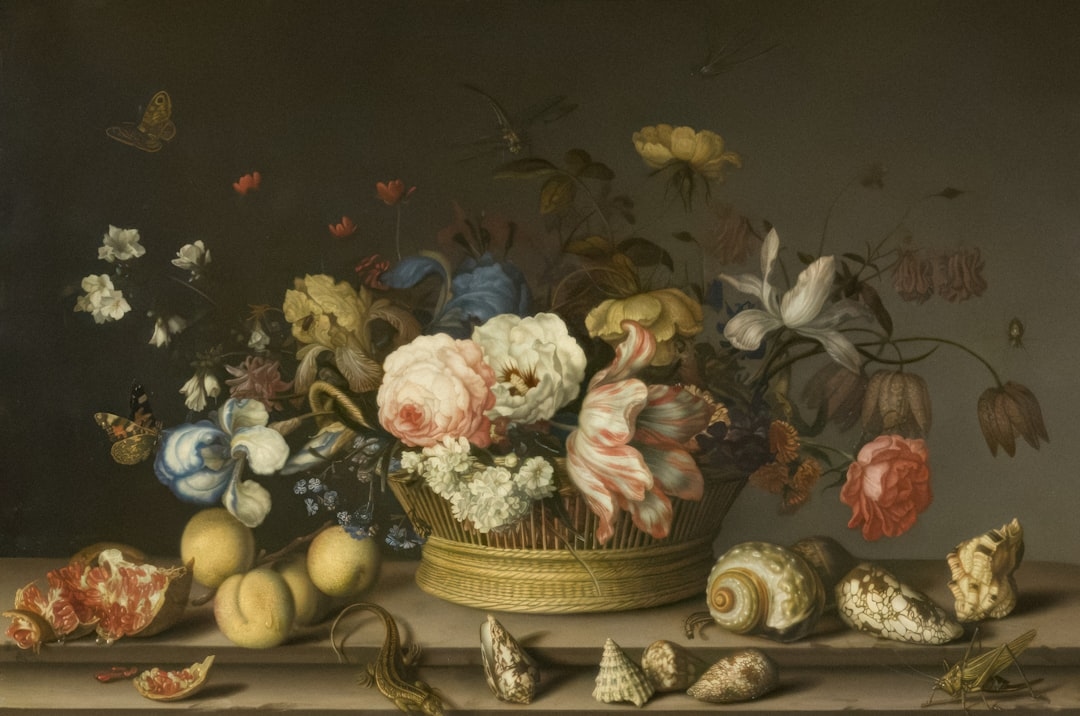
You’re standing in a museum gift shop, holding a print of a Dutch floral still life — roses spilling over a stone ledge, a butterfly perched on a petal, a single dewdrop catching imaginary light. It’s beautiful. You buy it, hang it in your kitchen, and think nothing more of it. But that painting you almost walked past? It was made during one of the most financially feverish periods in Western art history, by an artist who may never have seen half those flowers bloom in the same season. The story behind it is stranger, richer, and more human than the frame suggests.
Flowers have been embedded in visual art for over 4,000 years, carrying meaning that shifts with every century and culture. This flowers art history guide traces that arc from ancient Egypt through the Dutch Golden Age, Impressionism, Modernism, and into the installation art of today — with enough specific detail to make the timeline genuinely useful, whether you’re buying art, studying it, or just curious why a painted tulip once cost more than a house.
Quick Answer
Flowers in art history span at least four millennia. Ancient Egyptians used lotus motifs in tomb paintings as symbols of rebirth. Roman frescoes at Pompeii depicted garden flowers naturalistically. The Dutch Golden Age (roughly 1600–1700) produced the most technically sophisticated floral still lifes in Western history. French Impressionists — Monet, Renoir, Fantin-Latour — democratized flower painting in the late 19th century. Georgia O’Keeffe redefined floral imagery in the 20th century American context. Today, artists like Yayoi Kusama and Koons have turned flowers into large-scale cultural spectacles. Each era used flowers differently: as spiritual symbols, as status displays, as emotional vehicles, and as conceptual provocations.
Why Flowers? The Surprisingly Practical Reasons Art Kept Returning to Blooms
Before we get into the history, it’s worth asking a basic question: why flowers, specifically? They’re not the most durable subject. They die within days. They’re seasonally limited. And yet they appear in nearly every major artistic tradition on earth.
Part of the answer is structural. Flowers offer an artist everything at once — complex geometry, translucent color, layered texture, and built-in symbolic weight. A rose can suggest love, mortality, beauty, secrecy, or royal lineage depending on its color and context. No other natural form packs that much semiotic range into such a compact shape.
Part of the answer is also economic. Flowers were luxury goods for most of human history. Painting them conferred the same prestige as owning them. A patron who commissioned a floral still life was not just buying decorative art — they were broadcasting their taste, their wealth, and their cosmopolitan awareness of exotic species from distant continents.
“Flowers in painting have always been doing double duty,” explains Dr. Cecelia Voss, art historian and senior curator at a New England decorative arts institution with over 18 years specializing in botanical imagery. “They’re simultaneously the most naturalistic subject an artist can choose and the most loaded with cultural meaning. That tension is part of what makes floral art so endlessly generative.”
Ancient and Classical Roots: Flowers in Art Before the Canvas
Egypt and the Sacred Lotus
Egyptian floral art is at least 3,500 years old. The lotus (Nymphaea caerulea, the blue water lily native to the Nile) appears in tomb paintings, column capitals, jewelry, and papyrus scrolls throughout the New Kingdom period (1550–1070 BCE). Its significance wasn’t decorative — the lotus opened with the sun and closed at night, making it a natural symbol of creation, solar cycles, and resurrection. Tomb paintings at Thebes show lotus flowers in banquet scenes and offering arrangements with botanical accuracy that suggests careful observation, not stylization.
The Egyptians also cultivated cornflowers, poppies, mandrakes, and chrysanthemums for funerary garlands. Preserved garlands found in Tutankhamun’s tomb (circa 1323 BCE) included olive leaves, blue lotus petals, cornflowers, and wild celery — a snapshot of what a high-status Egyptian considered worth preserving into the afterlife.
Roman Frescoes and the Garden Room
Roman artists took flower painting in a more directly naturalistic direction. The most remarkable surviving example is the garden room fresco at the Villa of Livia (circa 30–20 BCE), now housed in the Palazzo Massimo in Rome. It depicts a continuous garden scene wrapping all four walls of a sunken triclinium — roses, oleander, pomegranate, iris, and laurel rendered with enough botanical specificity that modern botanists have identified individual species. It’s the closest thing the ancient world produced to a full garden painting, and it predates the Dutch florilegia by over 1,600 years.
The Medieval Period: Flowers as Theology
Medieval European art didn’t depict flowers for their beauty. It deployed them for their meaning. Every bloom in an illuminated manuscript or altarpiece was a theological statement, and viewers were expected to read it as such.
The white lily — specifically the Madonna lily (Lilium candidum) — became the dominant floral symbol of the Virgin Mary’s purity by the 12th century. It appears in Annunciation scenes so consistently that art historians use its presence as a dating and attribution tool. Simone Martini’s Annunciation (1333, Uffizi Gallery) positions a single white lily in a gold vase between the angel Gabriel and Mary — not as decoration, but as a visual argument about divine purity.
The red rose carried dual meaning: it represented both the blood of martyrs and divine love, which is why roses appear in images of both the Passion of Christ and courtly love scenes in secular manuscripts. Violets signaled humility. Strawberry flowers signaled righteousness (three-leafed, like the Trinity). Medieval flower symbolism was a visual language with grammar rules, and educated viewers could parse a painting’s theological argument by reading its botanical vocabulary.
The Dutch Golden Age: When Flowers Became an Art Form and a Financial Instrument
The Dutch Golden Age (approximately 1588–1672) produced the most technically extraordinary floral paintings in Western history, and the backstory is as compelling as the work itself. The Netherlands in the early 17th century was the wealthiest nation per capita in the world, fueled by global trade through the Dutch East India Company. New merchant wealth created a massive domestic art market — the first truly commercial art market in Europe — and flower paintings were among its most popular products.
The Impossible Bouquet and What It Tells Us
Here’s the thing about those lush Dutch flower arrangements: they’re fictional. Jan Brueghel the Elder, Ambrosius Bosschaert the Elder, Rachel Ruysch, and Jan Davidsz. de Heem all painted bouquets that combined flowers from different seasons, different climates, and different continents in a single vase. A single Bosschaert composition might include a tulip from April, a rose from June, an iris from May, and an exotic flower from the East Indies — botanically impossible as a simultaneous arrangement but visually and symbolically potent as a unified image.
These were painted from individual studies made at different times of year and compiled into a single composition. The resulting “impossible bouquet” communicated not just botanical knowledge but cosmopolitan reach — the painter’s access to rare specimens from distant places. A single Bosschaert floral painting sold in 1789 for the equivalent of what a skilled craftsman would earn in several years.
Tulip Mania and the Economics of Painted Flowers
Dutch floral art cannot be separated from Tulip Mania (1636–1637), the speculative bubble in which tulip bulb contracts briefly traded at prices exceeding that of a canal house in Amsterdam. At the peak, a single bulb of the rare “Semper Augustus” variety — white petals with red flames, caused by a mosaic virus that weakened the plant — was valued at approximately 10,000 guilders, equivalent to roughly $750,000 USD in modern purchasing power estimates.
Painted tulips became a way to own and display what you couldn’t necessarily afford in the ground. Florilegia — illustrated botanical catalogues of prized tulip varieties — were themselves art objects, handpainted and sold to collectors. The intersection of botanical obsession, speculative finance, and artistic virtuosity is uniquely Dutch, and it produced some of the most technically accomplished paintings in European history.
Rachel Ruysch: The Most Successful Woman Artist of Her Era
Rachel Ruysch (1664–1750) deserves far more name recognition than she typically receives. Working in Amsterdam and later as court painter to Johann Wilhelm, Elector Palatine, Ruysch commanded prices higher than most of her male contemporaries and continued painting until she was 86. Her compositions — typically large-format bouquets with birds’ nests, insects, and dewy petals — demonstrate a botanical knowledge unusual even among specialists; her father was a professor of botany and anatomy at the Amsterdam Athenaeum. A Ruysch original sold at Christie’s in 2018 for $1.4 million USD.
Flowers Art History Guide: The 18th and 19th Century Shift
Rococo Ornament and the Feminization of Floral Art
The 18th century brought a stylistic turn toward decorative excess. French Rococo painters — Boucher, Fragonard, Jean-Baptiste Monnoyer — used flowers as framing devices, textile-like ornament, and backdrops for pastoral scenes. The botanical precision of the Dutch masters gave way to softer, more atmospheric arrangements. Flowers became associated with femininity, leisure, and aristocratic refinement, a cultural shift that simultaneously elevated and diminished floral art — celebrated in decorative contexts, undervalued in the hierarchy of “serious” painting genres.
This era also saw the rise of botanical illustration as a rigorous scientific discipline. Pierre-Joseph Redouté, working in Paris during the late 18th and early 19th centuries and employed by both Marie Antoinette and Empress Joséphine, produced Les Roses (1817–1824), a three-volume illustrated catalogue of 169 rose varieties that remains one of the most exquisite botanical publications ever printed. First-edition copies have sold at auction for over $200,000 USD.
Impressionism: Flowers as Light, Not Symbol
The Impressionists made a radical break. For painters like Claude Monet, Pierre-Auguste Renoir, and Henri Fantin-Latour, flowers were not vehicles for theological or symbolic meaning — they were opportunities to study the behavior of light on organic form. The subject was almost incidental to the real investigation: how does color change in shadow? How does the eye perceive a rose at ten feet versus at arm’s length?
Monet’s garden at Giverny — which he designed himself beginning in 1883 and maintained obsessively until his death in 1926 — was explicitly conceived as a painting subject. He planted it to produce year-round material for his canvases, importing Japanese wisteria, growing specific iris varieties for their color relationships, and engineering the famous lily pond as a compositional device. The Water Lilies series, comprising approximately 250 paintings made between 1896 and 1926, is arguably the most sustained single-subject exploration in the history of Western painting.
Fantin-Latour took a different approach. Where Monet dissolved form into light, Fantin-Latour maintained a quiet fidelity to the physical presence of flowers — soft roses in ceramic bowls, peonies with slightly drooping heads, the specific weight of a half-open bud. His work became enormously popular in England and the United States, where his name recognition actually exceeded his reputation in France during his lifetime.
American Flower Painting: Regional Voices and a Distinctly National Vision
American flower painting developed its own character, shaped by geography and cultural self-consciousness about the relationship between the New World and European artistic tradition.
The Hudson River School and Native Botanicals
Painters associated with the Hudson River School in the mid-19th century — primarily known for landscape — occasionally incorporated native American flora as symbols of the nation’s natural abundance and moral purity. Martin Johnson Heade, working along the East Coast and later in Florida, produced a remarkable body of work combining hummingbirds and tropical orchids that reflected both scientific curiosity and a specifically American romantic vision of nature. His orchid and hummingbird paintings, largely ignored in his lifetime, now sell for $500,000 to $5 million USD at auction.
The Northeast’s art institutions — the Metropolitan Museum in New York, the Museum of Fine Arts in Boston, the Philadelphia Museum of Art — became custodians of both European floral tradition and American botanical art. If you’re on the East Coast, these institutions hold some of the most comprehensive collections of floral still life in the country, and most are accessible for under $30 admission.
The South: Magnolias, Camellias, and Plantation Imagery
Southern flower imagery developed in complicated relationship with plantation culture. Magnolias and camellias — both non-native species naturalized into Southern landscapes — became visual shorthand for a romanticized antebellum South in 19th-century illustration and decorative art. Contemporary Southern artists have spent the past 40 years complicating and interrogating that visual inheritance. Painter Radcliffe Bailey, based in Atlanta, uses floral motifs from traditional African textiles and Southern botanical history together as a way of reclaiming the narrative.
The West Coast: California Wildflowers and the Arts and Crafts Movement
California’s native flora — poppies, lupine, manzanita, coastal sage — became central to a distinctly West Coast visual identity in the late 19th and early 20th centuries. The Arts and Crafts movement, which flourished in Pasadena and the Bay Area between roughly 1890 and 1930, used stylized California wildflowers extensively in tile work, textile design, and watercolor. Artists like Granville Redmond painted the Central Valley in superbloom — fields of orange poppies rendered in loose, luminous brushwork that owed something to French Impressionism but felt climatically and botanically specific to California.
Georgia O’Keeffe and the American Redefinition of Floral Imagery
Georgia O’Keeffe’s large-scale flower paintings, produced primarily between 1924 and 1932, fundamentally altered how Americans understood floral art. The decision to paint flowers at massive scale — a single iris filling a 36-by-30-inch canvas — was deliberate and polemical. O’Keeffe argued that people walked past flowers without really seeing them, and that scale forced attention.
The persistent Freudian readings of her work — the suggestion that enlarged flowers are coded sexual imagery — were readings O’Keeffe spent her life refusing. “A flower is relatively small,” she wrote. “Everyone has many associations with a flower — the idea of flowers.” Her flowers were about the act of close looking, not about symbolism or sexuality. Whether you accept her framing or not, the paintings permanently changed the visual vocabulary available to American artists working with botanical subjects.
O’Keeffe’s later work in New Mexico shifted from flowers to bones and desert forms, but her influence on subsequent American painters working with natural subjects — from Alex Katz to contemporary botanical illustrators — is immeasurable. The Georgia O’Keeffe Museum in Santa Fe, New Mexico, holds the largest collection of her work, with over 1,100 pieces, and draws approximately 230,000 visitors annually.
Modern and Contemporary Floral Art: From Pop to Installation
Pop Art and the Denatured Flower
Andy Warhol’s Flowers series (1964) took a photograph of hibiscus blossoms from Modern Photography magazine and subjected it to silkscreen repetition in unnaturally saturated color combinations — hot pink on black, orange on yellow. The flowers are instantly recognizable and completely evacuated of their natural context. They don’t smell, they don’t wilt, they don’t carry Victorian symbolism. They’re products, reproducible images, consumer goods. The series — Warhol produced over 900 paintings in the format — is a direct commentary on what late capitalism does to natural beauty: flattens it, reproduces it, markets it.
Robert Mapplethorpe’s flower photographs, produced throughout the 1970s and 1980s, took a very different approach. Using large-format cameras and studio lighting, Mapplethorpe photographed calla lilies, roses, and orchids with the same formal rigor he applied to human bodies — treating petals and flesh as equivalent surfaces for the study of form, light, and erotic charge. A Mapplethorpe floral print sells today for $20,000 to $80,000 USD depending on edition size and condition.
Jeff Koons and the Flower as Monument
Puppy (1992), Koons’s 43-foot-tall West Highland Terrier constructed from a steel armature planted with approximately 70,000 flowering plants, is one of the most viewed public artworks in the world. Permanently installed at the Guggenheim Bilbao since 1997, it requires a seasonal replanting schedule — spring annuals replaced with winter-appropriate species twice yearly — and a full-time horticultural staff. It blurs the line between sculpture, gardening, architecture, and spectacle in a way that would have been conceptually impossible before the late 20th century.
Yayoi Kusama: Flowers as Infinity
Yayoi Kusama has been painting flowers obsessively since the 1950s, and her work has experienced a second major wave of global attention in the past decade driven in part by social media. Her dot-covered pumpkins and flower forms, her Infinity Mirror Rooms, and her large-scale outdoor installations have made her simultaneously one of the most Instagrammed artists on earth and one of the most rigorously serious. The dots are not decorative — they’re expressions of a specific psychological experience of self-obliteration that Kusama has described in detail in interviews and her memoir. Flowers, for Kusama, are simultaneously threatening and transcendent.
How Flowers Are Used in Art Today: Trends Worth Knowing
Contemporary floral art is moving in several directions simultaneously, which makes this a genuinely exciting moment to pay attention.
- Botanical illustration revival: After decades of being dismissed as craft rather than art, botanical illustration is experiencing serious critical rehabilitation. Illustrators like Wendy Hollender and Katie Scott are selling original works and prints at prices that would have been unthinkable twenty years ago, and institutions including Kew Gardens and the Hunt Institute for Botanical Documentation actively collect and exhibit new work.
- Floral installation art: Artists like Anne Ten Donkelaar (Netherlands) and Azuma Makoto (Japan) create large-scale three-dimensional flower compositions that exist primarily to be photographed and experienced briefly before decomposing. Makoto famously launched a bouquet of flowers into the stratosphere in 2014, photographed it against the curve of the earth, and produced a limited-edition print series that sold out immediately.
- Digital and generative floral art: AI-assisted floral imagery has exploded since 2026, creating both new artistic possibilities and significant market uncertainty. Some collectors are actively acquiring AI-assisted botanical works; others consider the category categorically ineligible for serious collection. The debate is unresolved and likely to remain so for years.
- Decolonial botanical perspectives: A growing number of contemporary artists are specifically interrogating whose flowers get painted and whose floral traditions get classified as “art” versus “craft” or “decoration.” Firelei Báez, Tschabalala Self, and Wangechi Mutu all engage with floral imagery through frameworks that foreground race, gender, and colonial botanical history.
Practical Tips: Building Your Own Relationship with Floral Art
Knowing the history is useful. Using it is more fun. Here are specific, actionable ways to engage with floral art as part of your everyday life.
Buying Floral Art: What to Know Before You Spend
The floral art market spans an enormous price range. At the accessible end, high-quality prints of Old Master floral paintings are available from museum shops and platforms like Artsy, Saatchi Art, and Minted for $50–$500 framed. Original contemporary floral paintings from emerging artists on platforms like Saatchi Art start around $200–$800 for small works. Signed prints from established photographers like Mapplethorpe or Mapplethorpe-era contemporaries start around $5,000–$10,000 at reputable galleries.
If you’re buying original work at any price point, ask for provenance documentation, understand the return policy, and photograph the work immediately upon receipt for insurance purposes. The latter is especially relevant for works over $1,000.
Visiting Collections: Where to See the Best Floral Art in the US
- The Metropolitan Museum of Art (New York): Dutch Golden Age florals, Impressionist flower paintings, and O’Keeffe works all under one roof. The Met’s collection of Rachel Ruysch and Jan van Huysum paintings is among the strongest in North America.
- The Art Institute of Chicago: Exceptional Impressionist holdings including significant Monet works, plus strong 20th-century American botanical art.
- The Georgia O’Keeffe Museum (Santa Fe, NM): The definitive O’Keeffe collection, set in the landscape that shaped her late career.
- The Huntington Library and Gardens (San Marino, CA): Uniquely combines a world-class botanical garden with significant collections of British and American flower painting. A West Coast institution that rewards multiple visits across seasons.
- The Walters Art Museum (Baltimore, MD): Particularly strong in medieval manuscript illumination with floral motifs and 17th-century Flemish still life. Free admission.
Growing Your Visual Literacy
The single most effective way to deepen your appreciation of floral art is to grow flowers yourself — even one pot of tulips on a city balcony. Understanding the physical reality of a bloom, its weight and translucency and the way light catches a petal differently at different times of day, changes how you read a painting of it. Dutch Masters made hundreds of drawings of individual flowers before composing their impossible bouquets. That observational discipline is available to anyone with a sketchbook and a farmers market nearby.
Frequently Asked Questions About Flowers in Art History
What period is considered the golden age of floral painting?
The Dutch Golden Age, roughly 1600–1700, is widely considered the peak of Western floral painting as a genre. Artists including Jan Brueghel the Elder, Ambrosius Bosschaert, Rachel Ruysch, and Jan Davidsz. de Heem produced botanically sophisticated, compositionally inventive flower paintings that remain technically unmatched. The period coincided with the Dutch East India Company’s global trade dominance, which made exotic botanical specimens available and made the ability to depict them a marker of wealth and status.
What do flowers symbolize in classical Western painting?
Symbolism varied by species and period. White lilies represented purity and the Virgin Mary in medieval and Renaissance art. Red roses signified divine love or martyrdom in religious contexts and romantic love in secular ones. Sunflowers, after their introduction to Europe from the Americas, became associated with devotion and the sun. Tulips in Dutch art often carried vanitas symbolism — a reminder of mortality, given their brief bloom. Irises were associated with both the Virgin Mary (as a substitute for the lily) and with French royalty through the fleur-de-lis.
Who were the most important women artists in floral painting history?
Rachel Ruysch (1664–1750) was the most commercially successful woman artist of her era and one of the finest Dutch flower painters regardless of gender. Maria Sibylla Merian (1647–1717) produced groundbreaking botanical illustration that combined scientific rigor with extraordinary artistry. In the 20th century, Georgia O’Keeffe redefined American floral painting entirely. Contemporary artists including Cecily Brown, whose work incorporates loose floral forms, and botanical illustrators like Wendy Hollender continue to expand the tradition.
How did Impressionism change flower painting?
The Impressionists shifted floral painting’s primary concern from symbolism and botanical accuracy to the study of light and perception. Monet, Renoir, and Fantin-Latour treated flowers as occasions to investigate how the eye processes color and form at different distances, in different lighting conditions. This stripped flowers of their theological and symbolic freight and repositioned them as vehicles for pure painterly investigation — a shift that influenced every subsequent generation of painters working with botanical subjects.
Is floral art considered serious fine art or decorative art?
The distinction has shifted considerably over time. In the 17th-century Dutch hierarchy of genres, still life (including flowers) ranked below history painting, portraiture, and landscape. By the 20th century, that hierarchy had largely collapsed. O’Keeffe’s flower paintings are unambiguously canonical fine art. So are Warhol’s Flowers and Mapplethorpe’s botanical photographs. Contemporary institutional collecting has further dissolved the boundary — Koons’s Puppy is in the permanent collection of the Guggenheim. The “decorative versus serious” debate is now mostly a market distinction rather than a critical one.
What Comes Next: Flowers and the Future of Art
The climate crisis is generating a new wave of floral art that takes the vulnerability of botanical life as its explicit subject. Artists like Isaac Julien and Andrea Polli are making work about endangered plant species, shifting bloom times due to warming temperatures, and the relationship between industrial agriculture and floral diversity. The flowers in this work are not symbols of beauty or vehicles for the study of light — they’re data points in an ongoing ecological emergency.
That’s a long way from a lotus carved in an Egyptian tomb column, or a mosaic-virus tulip traded for the price of a canal house in 1637. But the underlying impulse is recognizable across all of it: the human need to look very carefully at a flower, and to make that looking mean something.
Start your own looking. Pick one painting from this guide — a Ruysch, a Monet, a Mapplethorpe photograph — find a high-resolution image online, and spend ten minutes with it. Read the season into it. Find the insect or the dewdrop or the wilting petal the artist hid in a corner. The history is long, but every entry point into it opens outward.
+ There are no comments
Add yours